
Description
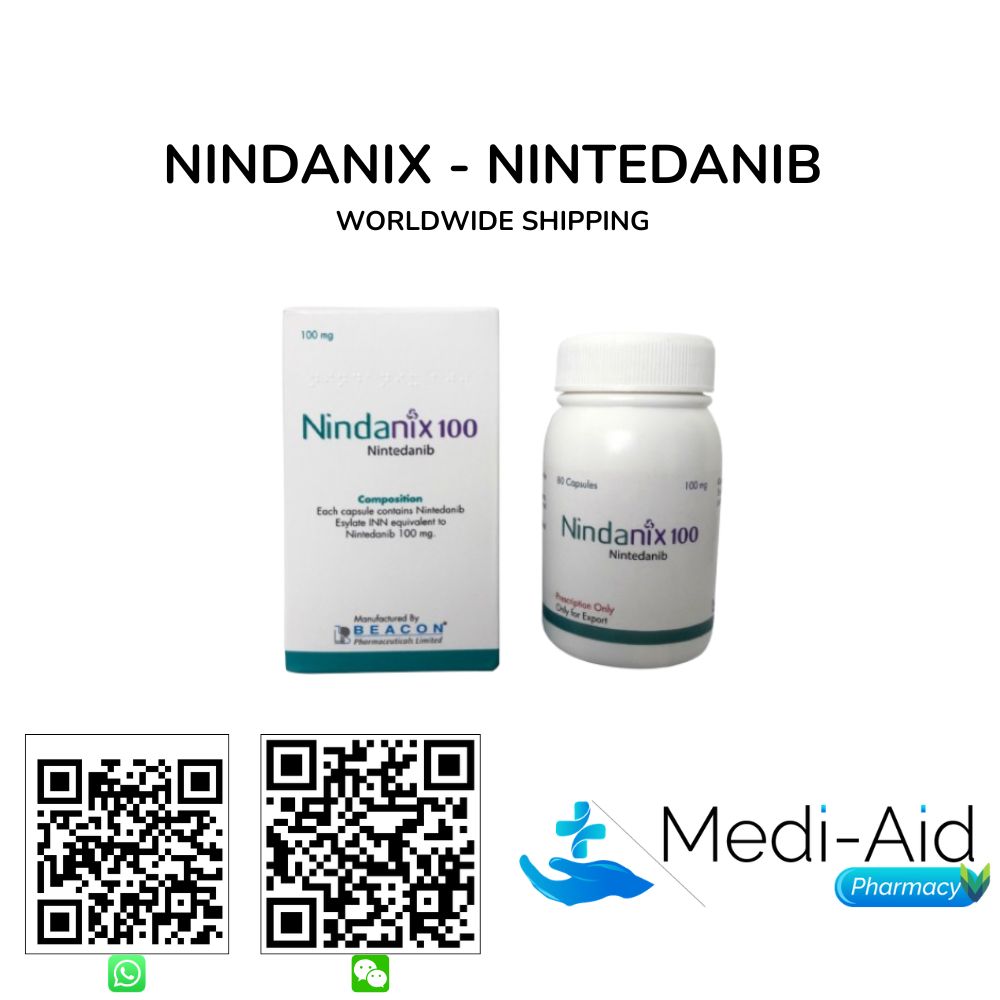
Nindanix (Nintedanib) 100mg and 150mg is an oral triple angiokinase inhibitor used to treat Idiopathic Pulmonary Fibrosis (IPF), other chronic fibrosing interstitial lung diseases (ILDs) with a progressive phenotype, and systemic sclerosis-associated ILD (SSc-ILD), and is also used in combination with docetaxel for certain patients with adenocarcinoma-type Non-Small Cell Lung Cancer (NSCLC). It works by inhibiting VEGFR-1, -2, and -3, FGFR-1, -2, and -3, and PDGFR-alpha/beta, blocking signalling pathways central to both fibrogenesis (the process driving scarring in lung tissue) and tumour angiogenesis, depending on the condition being treated. Manufactured by Beacon Pharmaceuticals PLC, Bangladesh and globally supplied by Mediaid Pharmacy with worldwide shipping.
Basic Product Information of Nindanix (Nintedanib) 100mg and 150mg
| Brand Name | Nindanix (Nintedanib) |
| Generic Name | Nintedanib (as Nintedanib Esilate) INN |
| Drug Class | Triple Angiokinase Inhibitor (VEGFR / FGFR / PDGFR Inhibitor) |
| Available Strengths | 100mg and 150mg |
| Formulation | Soft Gelatin Capsule |
| Pack Size | Available in Packs of 50 and 80 Capsules |
| Primary Indication | Idiopathic Pulmonary Fibrosis, Progressive Fibrosing ILDs, SSc-ILD, and NSCLC (Adenocarcinoma, with Docetaxel) |
| Regulatory Approvals | USFDA Approved (IPF, Progressive Fibrosing ILDs, SSc-ILD). EMA Approved (also NSCLC combination, under the Vargatef indication). |
| Originator Brand | Ofev (pulmonary indications) / Vargatef (NSCLC indication) by Boehringer Ingelheim |
| Manufacturer | Beacon Pharmaceuticals PLC, Mymensingh, Bangladesh |
| Global Supplier | Mediaid Pharmacy, Worldwide Shipping Available |
| Registration | Registered in Bangladesh |
| Storage Conditions | Store below 25 degrees Celsius. Keep in the original blister to protect from moisture. Keep out of the reach of children. |
How Nindanix (Nintedanib) Works
Nindanix contains Nintedanib, a small-molecule tyrosine kinase inhibitor that binds competitively to the ATP-binding pocket of three receptor families: VEGFR-1, -2, and -3 (vascular endothelial growth factor receptors), FGFR-1, -2, and -3 (fibroblast growth factor receptors), and PDGFR-alpha/beta (platelet-derived growth factor receptors). This blocks the intracellular signalling these receptors would otherwise trigger.
In fibrosing lung diseases such as IPF, this signalling is understood to drive the proliferation, migration, and transformation of fibroblasts into scar-forming cells, a central mechanism of progressive lung fibrosis. By interrupting this signalling, Nindanix has been shown in large clinical trials to significantly slow the annual rate of decline in lung function (forced vital capacity) and reduce the risk of acute exacerbations. In non-small cell lung cancer, the same VEGFR/FGFR/PDGFR-blocking mechanism instead targets the tumour blood supply and stromal signalling that support tumour growth, which is why Nindanix is used in this setting in combination with the chemotherapy agent docetaxel.
Nindanix is taken as a twice-daily oral capsule with food, with the dose and combination therapy tailored to the specific condition being treated.
Indications for Nindanix (Nintedanib)
Nindanix (Nintedanib) is indicated for the following conditions:
|
Idiopathic Pulmonary Fibrosis (IPF) For adult patients with IPF, a chronic, progressive scarring lung disease of unknown cause, to slow the decline in lung function. |
Progressive Fibrosing ILDs and SSc-ILD For other chronic fibrosing interstitial lung diseases with a progressive phenotype, and to slow the decline in pulmonary function in systemic sclerosis-associated interstitial lung disease. |
|
Non-Small Cell Lung Cancer (NSCLC), in Combination with Docetaxel In combination with docetaxel, for adult patients with locally advanced, metastatic, or locally recurrent NSCLC of adenocarcinoma tumour histology, following progression after first-line chemotherapy. |
|
Benefits of Nindanix (Nintedanib) 100mg and 150mg
|
Proven to Slow Lung Function Decline Landmark clinical trials (INPULSIS-1 and INPULSIS-2) demonstrated a significant reduction in the annual rate of FVC decline with Nintedanib compared to placebo in IPF patients. |
Broad Fibrosing Lung Disease Coverage Approved for IPF, other progressive fibrosing ILDs, and SSc-ILD, Nindanix supports patients across several related chronic lung conditions. |
Dual Therapeutic Role Nindanix is one of a small number of agents approved for both a chronic fibrosing lung disease and, separately, a lung cancer indication in combination with chemotherapy. |
|
Affordable Alternative to Ofev/Vargatef Nindanix contains the same active ingredient as Ofev and Vargatef by Boehringer Ingelheim, at a significantly lower cost, making long-term therapy more financially accessible. |
Two Strengths for Flexible Dosing The 100mg and 150mg capsules allow the standard dose, the reduced dose for tolerability, and the higher NSCLC combination dose to each be reached cleanly. |
WHO-GMP and cGMP Certified Produced by Beacon Pharmaceuticals PLC under strict WHO-GMP, cGMP, and ISO-certified manufacturing standards, ensuring every batch of Nindanix meets consistent quality, safety, and efficacy requirements. |
How to Take Nindanix (Nintedanib)
Route: Oral, taken with food. Capsules should be swallowed whole with liquid and not chewed or crushed, as the contents have a bitter taste.
Standard dose for IPF, progressive fibrosing ILDs, and SSc-ILD: 150mg (one 150mg capsule) taken twice daily, approximately 12 hours apart, continued long-term as directed by the treating pulmonologist.
Reduced dose for these indications: 100mg (one 100mg capsule) twice daily is used for patients with mild hepatic impairment (Child-Pugh A), or as a temporary or ongoing dose reduction to manage adverse reactions, as directed by the prescribing physician.
Standard dose for NSCLC (in combination with docetaxel): 200mg (two 100mg capsules) twice daily, taken on days 2 to 21 of each 21-day treatment cycle, alongside docetaxel given on day 1 of each cycle. Nindanix should not be taken on the same day as the docetaxel infusion. Patients who complete at least 4 combination cycles may continue Nindanix alone as maintenance therapy, given continuously.
Missed dose: If a dose is missed, take the next dose at its normal scheduled time; do not make up for a missed dose or exceed the recommended total daily dose.
Renal impairment: Nindanix has not been extensively studied in severe renal impairment or end-stage renal disease; use with caution as directed by the treating physician.
Smokers: Decreased drug exposure has been observed in smokers, which may reduce effectiveness; discuss smoking status and cessation with your physician.
Monitoring and Dosage Adjustments
Regular monitoring is essential throughout Nindanix treatment. Your physician will check liver function tests before starting treatment and periodically during therapy, with dose interruption or reduction guided by the degree of any transaminase elevation. Monitoring also includes assessment for signs of bleeding, blood pressure and cardiovascular risk factors, and, in patients with fibrosing lung disease, periodic lung function testing to track disease progression. Report any severe abdominal pain, unusual bleeding or bruising, yellowing of the skin or eyes, chest pain, sudden breathlessness, or signs of a blood clot to your doctor immediately.
Drug Interactions and Important Information
Nindanib is a substrate of P-glycoprotein (P-gp) and CYP3A4. Coadministration with strong P-gp or CYP3A4 inhibitors (such as ketoconazole or erythromycin) may increase Nintedanib exposure and the risk of adverse reactions, and patients should be monitored closely for tolerability. Coadministration with strong P-gp or CYP3A4 inducers (such as rifampicin, carbamazepine, phenytoin, and St. John’s Wort) may reduce Nintedanib exposure and effectiveness.
Use with caution alongside anticoagulants and antiplatelet agents, given the bleeding risk associated with Nindanix. Breastfeeding is not recommended during treatment. Women of childbearing potential should use effective contraception during treatment and for at least 3 months after the final dose. Always inform your physician of all medications, supplements, and herbal products you are currently taking before starting Nindanix.
Side Effects and Precautions
|
Common Side Effects Diarrhoea (the most frequently reported side effect) Nausea and vomiting Abdominal pain Decreased appetite and weight loss Headache Elevated liver enzymes |
Serious Warnings and Precautions Hepatotoxicity, including cases of significant liver injury requiring dose adjustment or discontinuation. Gastrointestinal perforation. Serious bleeding events. Arterial thromboembolic events, including myocardial infarction, and venous thromboembolic events including pulmonary embolism. Impaired wound healing. Interrupt treatment before planned surgery. Embryo-foetal toxicity. Not recommended during pregnancy or breastfeeding. |
Who Should Use Nindanix (Nintedanib)?
Nindanix is suitable for adult patients diagnosed with Idiopathic Pulmonary Fibrosis, another progressive fibrosing interstitial lung disease, or systemic sclerosis-associated ILD, typically confirmed by a multidisciplinary team of physicians, radiologists, and pathologists experienced in diagnosing fibrosing lung disease. It is also suitable for adult patients with adenocarcinoma-type NSCLC who have progressed after first-line chemotherapy and are being treated in combination with docetaxel. It is prescribed by pulmonologists or medical oncologists, depending on the indication. A thorough medical assessment including baseline liver function, cardiovascular risk, and bleeding risk is required before initiating treatment.
Manufacturer: Beacon Pharmaceuticals PLC
Beacon Pharmaceuticals PLC is a leading pharmaceutical manufacturer based in Mymensingh, Bangladesh, and the number one oncology and specialty medicine company in the country. Beacon is the first company in Bangladesh to export cancer drugs and currently exports to Asia, Africa, Europe, and Latin America. Beacon operates under strict WHO-GMP, cGMP, and ISO-certified standards, offering an affordable and bioequivalent alternative to Ofev and Vargatef by Boehringer Ingelheim at a fraction of the cost.
Global Supplier: Mediaid Pharmacy with Worldwide Shipping
Mediaid Pharmacy is a trusted global supplier of specialty and oncology medications. We ensure Nindanix (Nintedanib) is accessible to patients and healthcare providers worldwide through reliable worldwide shipping. Whether you are located in South Asia, the Middle East, Africa, Europe, or beyond, Mediaid Pharmacy provides fast and reliable delivery with full order support. Contact us directly via WhatsApp, phone, or WeChat for pricing, availability, and delivery enquiries.
Why Choose Nindanix (Nintedanib) from Mediaid Pharmacy?
Nindanix represents a proven option for both progressive fibrosing lung disease and, in combination with chemotherapy, adenocarcinoma NSCLC. As the generic equivalent of Ofev and Vargatef by Boehringer Ingelheim, it delivers the same active ingredient, Nintedanib, with the same proven triple angiokinase inhibition mechanism at a dramatically more affordable price. Manufactured by Beacon Pharmaceuticals PLC under WHO-GMP and cGMP standards, and distributed globally by Mediaid Pharmacy, Nindanix gives patients worldwide access to essential fibrosing lung disease and targeted lung cancer therapy without the financial burden of brand-name alternatives. For patients and physicians seeking a proven, affordable, and accessible Nintedanib option with worldwide delivery, Nindanix from Mediaid Pharmacy is the trusted choice.
Frequently Asked Questions About Nindanix (Nintedanib)
What is Nindanix (Nintedanib) used for?
Nindanix (Nintedanib) is used to treat Idiopathic Pulmonary Fibrosis, other progressive fibrosing interstitial lung diseases, and systemic sclerosis-associated ILD, where it slows the decline in lung function. It is also used, in combination with the chemotherapy drug docetaxel, for adenocarcinoma-type non-small cell lung cancer that has progressed after first-line chemotherapy.
How should I take Nindanix (Nintedanib)?
Nindanix is taken orally, twice daily, with food, approximately 12 hours apart. The standard dose for fibrosing lung disease is 150mg twice daily, with a 100mg twice-daily reduced dose for tolerability or mild hepatic impairment. For NSCLC combined with docetaxel, the dose is 200mg twice daily on days 2 to 21 of each cycle. Always follow your physician’s exact instructions, as dosing differs significantly by indication.
What strengths is Nindanix available in?
Nindanix is available in 100mg and 150mg soft gelatin capsules. Having both strengths available makes it possible to reach the standard dose, the reduced dose, and the higher NSCLC combination dose cleanly, exactly as prescribed by your physician.
Is Nindanix the same as Ofev or Vargatef (Nintedanib)?
Yes. Nindanix is the generic equivalent of both Ofev (used for fibrosing lung disease) and Vargatef (used for NSCLC in combination with docetaxel), both made by Boehringer Ingelheim. All contain the same active ingredient, Nintedanib. Nindanix is manufactured by Beacon Pharmaceuticals PLC in Bangladesh and offers the same clinical mechanism at a significantly lower cost.
What are the side effects of Nindanix (Nintedanib)?
The most common side effect is diarrhoea, along with nausea, abdominal pain, decreased appetite, and elevated liver enzymes. Serious but less common risks include liver injury, gastrointestinal perforation, serious bleeding, and blood clots. Always consult your physician for a complete assessment of your individual risks and benefits before starting treatment.
Can Nindanix be used with other medications?
Nindanix should be used with caution alongside strong P-gp or CYP3A4 inhibitors or inducers, and with anticoagulants or antiplatelet agents due to bleeding risk. For NSCLC, it is specifically used in combination with docetaxel, but should not be taken on the same day as the docetaxel infusion. Always inform your physician of all medications, supplements, and herbal products you are taking before starting Nindanix.
Is Nindanix (Nintedanib) safe during pregnancy or breastfeeding?
No. Nindanix is not recommended during pregnancy or breastfeeding, as it can cause foetal harm. Women of childbearing potential should use effective contraception during treatment and for at least 3 months after the final dose. Please consult your physician before starting treatment if you are pregnant, planning to become pregnant, or breastfeeding.
Can I order Nindanix (Nintedanib) online with worldwide shipping?
Yes. Mediaid Pharmacy supplies Nindanix (Nintedanib) 100mg and 150mg globally with worldwide shipping. Contact us via WhatsApp, phone, or WeChat at +8801773428128 or email us at info@mediaidpharmacy.com to enquire about pricing, availability, and delivery to your country.
Order Nindanix (Nintedanib) 100mg and 150mg with Worldwide Shipping
Phone / WhatsApp / WeChat: +8801773428128 | Email: info@mediaidpharmacy.com
Reviews
There are no reviews yet.