
Description
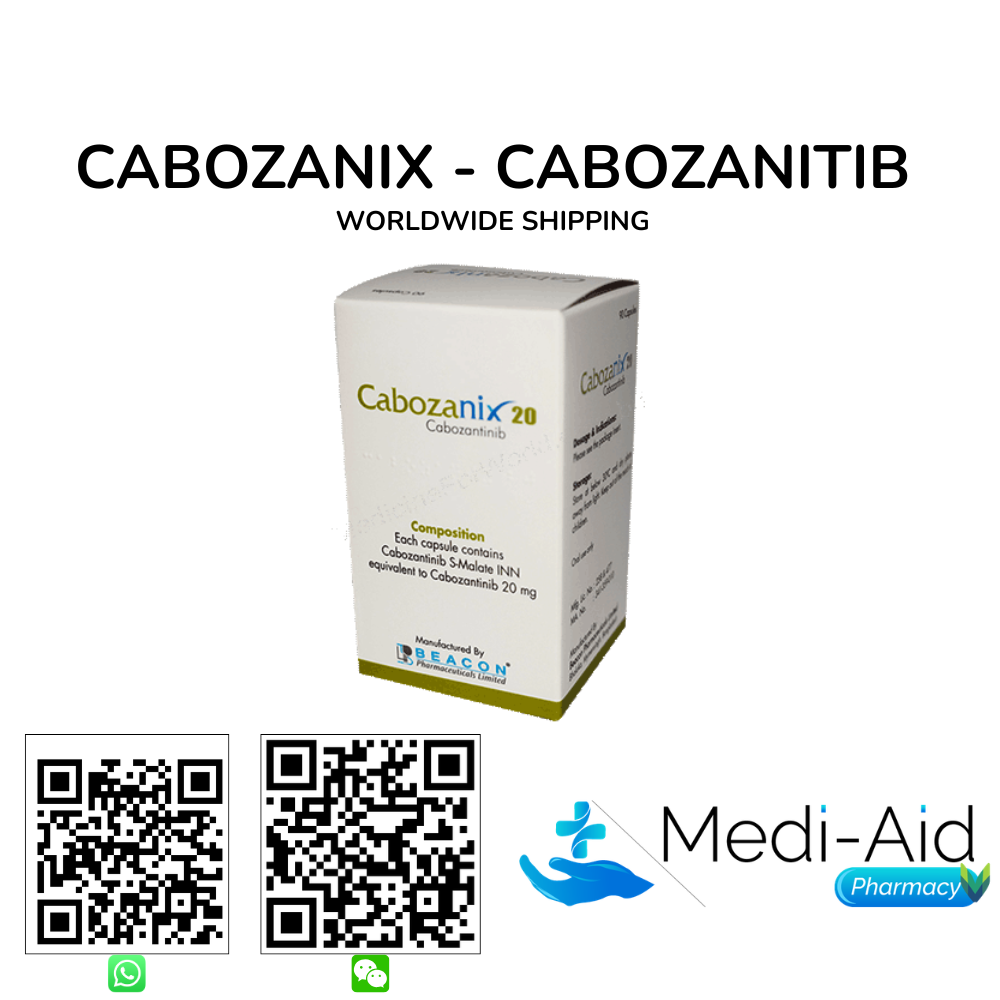
Cabozanix 20MG & 60MG (Cabozantinib) is a potent oral multi-kinase inhibitor that simultaneously targets VEGFR-1, VEGFR-2, VEGFR-3, MET (hepatocyte growth factor receptor), AXL, and RET a uniquely broad kinase inhibition profile that suppresses tumour angiogenesis, overcomes resistance mechanisms, and reduces invasion and metastatic potential across multiple cancer types. Cabozanix is indicated for advanced Renal Cell Carcinoma (RCC), Hepatocellular Carcinoma (HCC), Medullary Thyroid Cancer (MTC), and Differentiated Thyroid Cancer (DTC). Oncologists and patients requiring a comprehensive oncology and targeted cancer medicines portfolio can consult Mediaid Pharmacy’s full range of specialty oncology treatments. Cabozanix is manufactured by Beacon Pharmaceuticals Ltd., Bangladesh and globally supplied by Mediaid Pharmacy with worldwide shipping.
Basic Product Information of Cabozanix 20MG & 60MG (Cabozantinib)
| Brand Name | Cabozanix (Cabozantinib) |
| Generic Name | Cabozantinib INN |
| Drug Class | Oral Multi-Kinase Inhibitor VEGFR-1, VEGFR-2, VEGFR-3, MET, AXL, RET, KIT, FLT3 |
| Available Strengths | 20mg and 60mg |
| Formulation | Film-Coated Tablet |
| Pack Size | 90 Tablets per Pot (20mg) & 30 Tablets per Pot (60mg) |
| Primary Indications | Advanced Renal Cell Carcinoma (RCC) monotherapy and combination with nivolumab; Hepatocellular Carcinoma (HCC) following sorafenib; Medullary Thyroid Cancer (MTC); Differentiated Thyroid Cancer (DTC) |
| Regulatory Approvals | USFDA Approved (RCC 2016, HCC 2019, first-line RCC + nivolumab 2021, DTC 2021). EMA Approved (RCC, HCC, DTC, NET). Health Canada Approved. |
| Originator Brand | Cabometyx by Exelixis / Ipsen (tablet); Cometriq by Exelixis (capsule separate formulation for MTC) |
| Manufacturer | Beacon Pharmaceuticals Ltd., Mymensingh, Bangladesh |
| Global Supplier | Mediaid Pharmacy Worldwide Shipping Available |
| Registration Status | Export Only |
| Storage Conditions | Store below 30°C in a dry place away from light and moisture. Keep out of the reach of children. |
How Cabozanix 20MG & 60MG (Cabozantinib) Works Multi-Kinase Inhibition of VEGFR, MET, AXL, and RET
Cabozantinib, the active ingredient in Cabozanix 20MG & 60MG, is a potent small-molecule multi-kinase inhibitor that simultaneously blocks several receptor tyrosine kinases (RTKs) central to tumour biology: VEGFR-1, VEGFR-2, VEGFR-3 (anti-angiogenic axis), MET (hepatocyte growth factor receptor), AXL (TAM family kinase), RET (rearranged during transfection), KIT, and FLT3. This multi-target profile distinguishes Cabozanix from single-pathway VEGFR inhibitors such as sunitinib or axitinib, enabling it to simultaneously suppress tumour vascularisation and overcome the resistance mechanisms that commonly develop after first-line anti-angiogenic therapy.
The IC50 values of Cabozantinib reflect its exceptional potency: VEGFR-2 at 0.035 nmol/L, MET at 1.3 nmol/L, KIT at 4.6 nmol/L, RET at 5.2 nmol/L, AXL at 7 nmol/L, and FLT3 at 11.3 nmol/L. In Renal Cell Carcinoma, inactivation of the Von Hippel-Lindau (VHL) tumour suppressor gene leads to upregulation of VEGF, MET, and AXL all three of which are directly inhibited by Cabozanix. Critically, chronic use of earlier VEGFR inhibitors (sunitinib, sorafenib, axitinib) drives tumour escape via MET and AXL upregulation. By simultaneously blocking both pathways, Cabozanix rescues acquired VEGFR-TKI resistance that renders tumours insensitive to earlier-generation targeted agents. Preclinical studies confirmed that in sunitinib-resistant models, Cabozantinib suppressed both MET and AXL activation and restored tumour growth control.
Beyond its anti-angiogenic and anti-resistance activity, Cabozantinib exerts immunomodulatory effects within the tumour microenvironment (TME) by inhibiting TAM family kinases (TYRO3, MER, and AXL), which normally suppress anti-tumour immune responses. This immunological mechanism provides a strong biological rationale for the combination of Cabozanix with immune checkpoint inhibitors such as nivolumab, as validated in the CheckMate-9ER first-line RCC trial. Oncologists managing complex multi-line cancer treatments can review the complete oncology medicines portfolio at Mediaid Pharmacy for combination partners and other targeted cancer therapies.
Approved Indications for Cabozanix 20MG & 60MG (Cabozantinib)
Cabozanix (Cabozantinib) 20mg and 60mg is approved for the following oncological indications in adult patients:
|
Advanced Renal Cell Carcinoma (RCC) Monotherapy Cabozanix 60mg once daily is indicated as monotherapy for advanced RCC in treatment-naïve adults with intermediate or poor IMDC risk, and in adults following prior VEGF-targeted therapy. This indication is supported by the Phase III METEOR trial (658 patients), in which Cabozantinib demonstrated a 42% reduction in disease progression risk versus everolimus, a 4.9-month overall survival benefit, and superior objective response rates across all patient subgroups including those with bone metastases. USFDA approved 2016; EMA approved. |
Advanced RCC First-Line Combination with Nivolumab Cabozanix 40mg once daily in combination with nivolumab (anti-PD-1; 240mg every 2 weeks or 480mg every 4 weeks IV) is approved for first-line treatment of advanced RCC across all IMDC risk groups. The CheckMate-9ER trial demonstrated progression-free survival of 16 months versus 8 months for sunitinib, with improved overall survival (47 vs. 36 months) and objective response rates. USFDA approved 2021. |
|
Hepatocellular Carcinoma (HCC) Cabozanix 60mg once daily is indicated as monotherapy for adult patients with hepatocellular carcinoma (HCC) previously treated with sorafenib. This indication was established in the CELESTIAL Phase III trial, in which Cabozantinib demonstrated significantly improved overall survival and progression-free survival versus placebo in patients with advanced HCC previously treated with sorafenib. USFDA approved 2019; EMA approved. |
Differentiated Thyroid Cancer (DTC) & Medullary Thyroid Cancer (MTC) Cabozanix 60mg once daily is indicated for adult and paediatric patients aged 12 and above with locally advanced or metastatic differentiated thyroid cancer (DTC) that has progressed following prior VEGFR-targeted therapy. For medullary thyroid cancer (MTC), where RET mutations drive tumorigenesis in hereditary and sporadic forms (up to 50% of sporadic MTC cases harbour RET mutations), Cabozantinib’s potent RET inhibition (IC50 5.2 nmol/L) makes it a mechanistically well-matched treatment option. |
Key Clinical Benefits of Cabozanix (Cabozantinib) 20mg and 60mg
|
Unique Triple Pathway Blockade VEGFR + MET + AXL No other approved VEGFR-targeted TKI simultaneously inhibits MET and AXL the two primary escape pathways responsible for acquired resistance to earlier anti-angiogenic agents. This triple blockade is what enables Cabozanix to remain active in patients who have already progressed on sunitinib, sorafenib, or axitinib. |
METEOR Trial 42% Risk Reduction vs Everolimus In the pivotal Phase III METEOR trial (658 patients with advanced RCC), Cabozantinib achieved a 42% reduction in disease progression risk versus everolimus, a 4.9-month overall survival benefit, and superior objective response rates across every patient subgroup including patients with bone metastases, where outcomes were even more pronounced. |
CheckMate-9ER PFS Doubled vs Sunitinib in First Line In the CheckMate-9ER trial, Cabozantinib plus nivolumab doubled median PFS (16 vs. 8 months) and improved overall survival by 11 months (47 vs. 36 months) versus sunitinib in the first-line advanced RCC setting across all IMDC risk categories making it one of the most effective first-line regimens in kidney cancer. |
|
Broad Multi-Cancer Activity Cabozanix is one of the few targeted agents approved across four distinct cancer types advanced RCC, HCC, MTC, and DTC reflecting the central role of VEGFR, MET, AXL, and RET in multiple tumour histologies and making it a versatile backbone in multi-tumour oncology practice. |
Flexible Pack Sizes for Full Dose Titration The 90-tablet 20mg pot enables precise down-titration from 60mg to 40mg and then to 20mg once daily for adverse event management, while the 30-tablet 60mg pot provides a convenient monthly supply at the standard monotherapy dose together covering the complete dose range used in clinical practice. |
Affordable Generic Alternative to Cabometyx Cabozanix contains the same active ingredient as Cabometyx (Exelixis/Ipsen), manufactured by Beacon Pharmaceuticals Ltd. under WHO-GMP and cGMP standards delivering the same proven multi-kinase inhibition at a significantly lower cost and making long-term advanced cancer treatment financially accessible to patients worldwide. |
How to Take Cabozanix 20MG & 60MG (Cabozantinib) Dosage and Administration Guidelines
Route of Administration: Oral swallowed whole with a glass of water. Do not crush or split the tablet. Must not be taken with food; the patient must fast for at least 2 hours before and at least 1 hour after taking each dose of Cabozanix.
Standard Monotherapy Dose (RCC, HCC, DTC, NET): 60mg once daily. Treatment should continue until the patient is no longer clinically benefiting from therapy or until unacceptable toxicity occurs.
Combination with Nivolumab (First-Line Advanced RCC): Cabozanix 40mg once daily combined with nivolumab 240mg IV every 2 weeks or 480mg IV every 4 weeks. Continue both until disease progression, unacceptable toxicity, or up to 24 months for nivolumab in patients without disease progression.
Dose Reduction for Adverse Events: First reduction: 40mg once daily. Second reduction: 20mg once daily. The 20mg strength of Cabozanix (90-tablet pot) directly supports each dose reduction step with a single tablet. Permanently discontinue if the patient cannot tolerate 20mg once daily.
Strong CYP3A4 Inhibitors: Reduce the daily Cabozanix dose by 20mg when co-administering with strong CYP3A4 inhibitors (e.g., clarithromycin, ketoconazole, itraconazole, grapefruit juice). Avoid grapefruit and grapefruit juice during treatment.
Strong CYP3A4 Inducers: Increase the daily Cabozanix dose by 20mg (maximum 80mg per day) when co-administering with strong CYP3A4 inducers (e.g., rifampin, carbamazepine, phenytoin, St. John’s Wort). Restore the original dose 2 to 3 days after stopping the inducer.
Hepatic Impairment: No dose adjustment is required for mild hepatic impairment (Child-Pugh Class A). Reduce to 40mg once daily for moderate hepatic impairment (Child-Pugh Class B). Cabozanix is not recommended for patients with severe hepatic impairment (Child-Pugh Class C).
Renal Impairment: No dose adjustment is required for mild to moderate renal impairment. Limited data are available for severe renal impairment; use with caution.
Missed or Vomited Dose: If a dose is missed and the next scheduled dose is within 12 hours, skip the missed dose. If the patient vomits after taking the tablet, do not take a replacement dose; take the next dose at the scheduled time.
Clinical Monitoring Requirements During Cabozanix (Cabozantinib) Treatment
Comprehensive clinical monitoring is mandatory throughout Cabozanix treatment. Blood pressure must be monitored and hypertension controlled before and throughout therapy; uncontrolled hypertension warrants dose interruption and antihypertensive management. Electrolytes particularly serum calcium, potassium, and phosphate require regular testing, as hypocalcaemia, hypokalaemia, and hypophosphataemia are commonly observed early in treatment. Liver function tests (LFTs) including ALT, AST, and total bilirubin should be monitored regularly, especially in patients with baseline hepatic impairment or HCC. Urinalysis for proteinuria is required; suspend Cabozanix for Grade 3 or above proteinuria until resolution to Grade 1 or below. Clinicians should monitor for clinical signs of haemorrhagic events (gastrointestinal bleeding, haematuria, cerebral haemorrhage), gastrointestinal perforation or fistula formation, thromboembolic events, osteonecrosis of the jaw (ONJ), and Reversible Posterior Leukoencephalopathy Syndrome (RPLS). Thyroid function should be assessed periodically, as hypothyroidism occurs during Cabozantinib treatment.
Drug Interactions and Important Safety Information for Cabozanix (Cabozantinib)
Cabozantinib is metabolised primarily by hepatic CYP3A4 enzymes. Strong CYP3A4 inhibitors including clarithromycin, ketoconazole, itraconazole, voriconazole, and grapefruit products significantly increase Cabozantinib plasma concentrations, requiring a 20mg daily dose reduction. Strong CYP3A4 inducers including rifampin, carbamazepine, phenytoin, phenobarbital, and St. John’s Wort substantially reduce Cabozantinib exposure; where clinically necessary, increase the daily dose by 20mg up to a maximum of 80mg per day, and restore the original dose 2 to 3 days after the inducer is stopped.
Cabozantinib is a substrate and inhibitor of P-glycoprotein (P-gp), which may affect the pharmacokinetics of co-administered P-gp substrates. Concomitant anticoagulant therapy requires close monitoring for haemorrhage risk, as Cabozantinib itself increases bleeding risk. Patients should disclose all current medications, herbal supplements, and dietary habits particularly grapefruit consumption to their treating oncologist before starting Cabozanix.
Side Effects and Precautions of Cabozanix (Cabozantinib)
|
Common Side Effects (>20% Incidence) Diarrhoea Hypertension monitor blood pressure closely throughout treatment Fatigue Palmar-Plantar Erythrodysaesthesia Syndrome (PPES / Hand-Foot Syndrome) Nausea and vomiting Decreased appetite and weight loss Mucosal inflammation and stomatitis Hypocalcaemia, hypokalaemia, hypophosphataemia Dysphonia (hoarseness) Hypothyroidism monitor thyroid function throughout treatment |
Serious Warnings and Precautions Haemorrhagic events including gastrointestinal bleeding, haematuria, haemoptysis, and cerebral haemorrhage. Contraindicated in patients with active uncontrolled bleeding or recent major haemorrhagic events. Gastrointestinal perforation and fistula formation potentially fatal. Discontinue Cabozanix if GI perforation or grade 4 fistula occurs. Venous and arterial thromboembolic events including DVT, pulmonary embolism, myocardial infarction, and stroke use with caution in patients with cardiovascular risk factors. Wound healing complications withhold Cabozanix at least 28 days before elective surgery; do not restart until adequate wound healing is confirmed. Osteonecrosis of the Jaw (ONJ) dental examination is recommended before initiating Cabozanix; avoid invasive dental procedures during treatment. Reversible Posterior Leukoencephalopathy Syndrome (RPLS) discontinue immediately if confirmed. Symptoms include headache, seizure, visual disturbances, confusion, and lethargy. Proteinuria assess urine protein regularly; suspend treatment for Grade 3 or above proteinuria. Not recommended during pregnancy or breastfeeding. Effective contraception required for both women and men during treatment and for at least 4 months after the final dose. |
Who Should Use Cabozanix 20MG & 60MG (Cabozantinib)?
Cabozanix is indicated for adult oncology patients with advanced or metastatic Renal Cell Carcinoma (RCC) either as first-line combination therapy with nivolumab for intermediate or poor-risk disease, or as monotherapy following progression on prior VEGFR-targeted therapy; adult patients with Hepatocellular Carcinoma (HCC) previously treated with sorafenib; adult and paediatric patients aged 12 and above with Differentiated Thyroid Cancer (DTC) progressing on prior VEGFR-targeted therapy; and patients with Medullary Thyroid Cancer (MTC) where RET-driven signalling is central to tumorigenesis. Treatment with Cabozanix must be initiated and supervised by a qualified oncologist or specialist physician experienced in advanced cancer therapy. A pre-treatment assessment including blood pressure, electrolytes, LFTs, urinalysis, thyroid function, and evaluation for active bleeding risk or planned surgery is mandatory before starting Cabozanix. For the full range of oncology and specialty cancer medicines available through Mediaid Pharmacy, including combination partners such as nivolumab and other targeted oncology treatments, visit the oncology medicines page.
Manufacturer: Beacon Pharmaceuticals Ltd., Bangladesh
Beacon Pharmaceuticals Ltd. is a leading pharmaceutical manufacturer based in Mymensingh, Bangladesh and the number one oncology and specialty medicine company in the country. Beacon was the first company in Bangladesh to export cancer medicines and currently exports to markets across Asia, Africa, Europe, and Latin America. With more than 200 generic drugs and 65 oncology products in its portfolio, Beacon operates under strict WHO-GMP, cGMP, and ISO-certified manufacturing standards. Cabozanix (Cabozantinib) 20mg and 60mg is one of Beacon’s flagship oncology products, offering a high-quality, bioequivalent, and affordable alternative to Cabometyx (Exelixis/Ipsen) at a fraction of the originator cost. Every batch of Cabozanix exported by Beacon meets the quality, purity, and bioequivalence requirements validated for international supply to regulated markets.
Global Supplier: Mediaid Pharmacy Worldwide Shipping for Cabozanix (Cabozantinib)
Mediaid Pharmacy is a trusted global supplier of specialty oncology and targeted cancer therapy medications. Cabozanix (Cabozantinib) 20mg and 60mg is available through Mediaid Pharmacy with reliable worldwide shipping to South Asia, the Middle East, Africa, Europe, and beyond. Our team provides full order support including pricing, availability confirmation, export documentation, and delivery tracking for oncologists, hospitals, cancer centres, and patients requiring Cabozanix internationally. Contact Mediaid Pharmacy directly via WhatsApp, phone, or WeChat for enquiries about pricing and delivery to your country.
Why Choose Cabozanix (Cabozantinib) from Mediaid Pharmacy?
Cabozanix represents a clinically proven advancement in the treatment of advanced kidney cancer, liver cancer, and thyroid malignancies. As the generic bioequivalent of Cabometyx (Exelixis/Ipsen), Cabozanix delivers the same active ingredient Cabozantinib with the same unique multi-kinase inhibition of VEGFR, MET, AXL, and RET, at a dramatically more affordable price. The availability of both the 20mg strength (90-tablet pot) for complete dose titration management and the 60mg strength (30-tablet pot) for standard monotherapy supply makes Cabozanix uniquely well-suited to every dosing scenario encountered in real-world advanced oncology practice. Manufactured by Beacon Pharmaceuticals Ltd. under WHO-GMP and cGMP standards, and distributed globally by Mediaid Pharmacy with worldwide shipping, Cabozanix is the trusted choice for oncologists and patients seeking proven, affordable multi-kinase inhibitor therapy. For a comprehensive range of oncology medicines including targeted therapies, checkpoint inhibitors, and specialty cancer treatments, visit Mediaid Pharmacy’s oncology medicines portfolio.
Frequently Asked Questions About Cabozanix 20MG & 60MG (Cabozantinib)
What is Cabozanix 20MG & 60MG (Cabozantinib) used for?
Cabozanix (Cabozantinib) 20mg and 60mg is a multi-kinase inhibitor that simultaneously targets VEGFR-1, VEGFR-2, VEGFR-3, MET, AXL, and RET. It is indicated for advanced Renal Cell Carcinoma (RCC) as monotherapy and in combination with nivolumab Hepatocellular Carcinoma (HCC) following sorafenib, Differentiated Thyroid Cancer (DTC) progressing on prior VEGFR-targeted therapy, and Medullary Thyroid Cancer (MTC). Its unique VEGFR + MET + AXL triple blockade enables it to overcome the resistance mechanisms that limit the effectiveness of earlier VEGFR-only agents.
What is the correct dose of Cabozanix (Cabozantinib)?
The standard monotherapy dose of Cabozanix for RCC, HCC, DTC, and NET is 60mg once daily taken on an empty stomach at least 2 hours before and 1 hour after eating. When used in combination with nivolumab for first-line advanced RCC, the dose is 40mg once daily. Dose reductions to 40mg and then 20mg once daily are used to manage adverse events. The maximum permitted daily dose is 80mg when co-administered with strong CYP3A4 inducers. Always follow your treating oncologist’s exact dosing instructions.
What strengths and pack sizes is Cabozanix (Cabozantinib) available in?
Cabozanix is available in 20mg film-coated tablets supplied in a pot of 90 tablets, and 60mg film-coated tablets supplied in a pot of 30 tablets. The 60mg pot delivers a standard once-daily 30-day supply at the monotherapy dose. The 90-tablet 20mg pot enables precise down-titration and covers combination dosing at 40mg once daily (two tablets) as well as the 20mg dose reduction step. Both strengths and packs are required to manage the complete clinical dose range of 20mg to 80mg once daily.
Is Cabozanix the same as Cabometyx (Cabozantinib by Exelixis/Ipsen)?
Yes. Cabozanix is the generic equivalent of Cabometyx. Both products contain the same active ingredient Cabozantinib in the same film-coated tablet formulation and clinical dose strengths. Cabozanix is manufactured by Beacon Pharmaceuticals Ltd. in Bangladesh under WHO-GMP-certified conditions and delivers the same multi-kinase inhibition of VEGFR, MET, AXL, and RET as Cabometyx, at a significantly lower cost making advanced cancer treatment more financially accessible to patients worldwide.
What are the most common side effects of Cabozanix (Cabozantinib)?
The most common side effects of Cabozanix (occurring in more than 20% of patients) include diarrhoea, hypertension, fatigue, palmar-plantar erythrodysaesthesia syndrome (hand-foot syndrome), nausea, decreased appetite, mucosal inflammation, and dysphonia. Electrolyte abnormalities particularly hypocalcaemia, hypokalaemia, and hypophosphataemia are common and require monitoring, especially early in treatment. Serious risks include haemorrhagic events, gastrointestinal perforation, thromboembolic events, osteonecrosis of the jaw, and Reversible Posterior Leukoencephalopathy Syndrome (RPLS). Always consult your oncologist for a full individual risk assessment before and during treatment.
Can Cabozanix (Cabozantinib) be used with nivolumab or other immunotherapy?
Yes. Cabozantinib is approved in combination with nivolumab (anti-PD-1 checkpoint inhibitor) for the first-line treatment of adult patients with advanced RCC across all IMDC risk groups, based on the CheckMate-9ER trial. Cabozantinib’s inhibition of TAM family kinases (TYRO3, MER, AXL), which suppress anti-tumour immunity, provides a strong mechanistic rationale for this combination, as these kinases normally dampen the immune response that nivolumab is designed to restore. The combination significantly improved PFS (16 vs. 8 months) and OS (47 vs. 36 months) versus sunitinib in this setting.
Does Cabozanix (Cabozantinib) require dose adjustment for CYP3A4 drug interactions?
Yes. Reduce the daily Cabozanix dose by 20mg when co-administering with strong CYP3A4 inhibitors such as clarithromycin, ketoconazole, or grapefruit products, as these significantly increase Cabozantinib plasma concentrations. Increase the daily dose by 20mg (maximum 80mg) when co-administering with strong CYP3A4 inducers such as rifampin or carbamazepine, which reduce Cabozantinib plasma exposure. Restore the original dose 2 to 3 days after stopping any inducer. Always disclose all medications and supplements to your treating oncologist before starting Cabozanix.
Can I order Cabozanix 20MG & 60MG (Cabozantinib) online with worldwide shipping?
Yes. Mediaid Pharmacy supplies Cabozanix (Cabozantinib) 20mg and 60mg to patients, oncologists, hospitals, and healthcare facilities globally with worldwide shipping. Contact Mediaid Pharmacy via WhatsApp, phone, or WeChat at +8801773428128, or send your enquiry to info@mediaidpharmacy.com for pricing, stock availability, export documentation, and delivery details for your country.
Order Cabozanix 20MG & 60MG (Cabozantinib) with Worldwide Shipping
Phone / WhatsApp / WeChat: +8801773428128 | Email: info@mediaidpharmacy.com
Reviews
There are no reviews yet.